Showing posts with label book reviews. Show all posts

Happy Desk Salad - Arugula Salad with Proscuitto, Basil, and Goat Cheese

Maybe you've heard of Sad Desk Salad. I'm reading it now. Luckily, I don't work (or blog) in such a charged environment, but the concept of being stuck at your desk for lunch definitely resonates. Also in the news of eating lunch at your desk, you should only do it if you make the conscious decision to do so

If you find yourself at your desk for lunch, one way or the other, a great salad can go a long way in making the experience a decent one. It's just as easy (if not easier) than walking across the street to the bodega for a  limp salad - just throw some great tasting greens in a container, roll the meat into some plastic wrap, and put the dressing in a separate container. Mix it all together at your desk, and voila - a happy desk salad. It's crisp, satisfying, and totally free from despair.
This salad just so happens to have some kale and chive sprouts from my garden - a lucky coincidence of needing to thin out veggies. But it would be equally delicious with just the arugula and mesclun mix.
Arugula Salad with Prosciutto, Basil and Goat Cheese 


Homemade Pantry: 101 Foods You Can Stop Buying and Start Making

I love a cookbook with a story. And I love a cookbook with good pictures. Even better is a cookbook that has both. What's more, Alana Chernila's sensibilities about food speak to my own. Food doesn't have to be expensive to be delicious, and food made from scratch with love is almost always vastly superior to the store-bought kind.


I stumbled across Homemade Pantry: 101 Foods You Can Stop Buying and Start Making through another blog I read, and instantly put it on my "books to buy" list. (They're almost all cookbooks. The rest I try to check out from the library.) My little brother gave it to me for Christmas, and I immediately read the entire thing from cover to cover.

Homemade Pantry contains a lot of recipes I have down pat, or similar to those in other cookbooks I own. And I will have to tweak many of the recipes because they call for wheat flour. But that's not the point. The point is the approach to cooking, how food relates to everyday life in so many ways, how it can nourish our bodies and relationships with each other. As an added bonus, there are plenty of recipes I have tabbed that don't require any modification, like the oven baked potato chips that have my mouth watering just thinking about them.  Plus, Chernila walks you through difficult spots (she calls them "tense moments") that might come up in cooking the recipes, and gives tips on what to do with scraps you might otherwise send to the landfill. She knows nobody really lives that perfect at-home life so many bloggers portray, so she also tells you how long each dish keeps in the fridge and freezer for those nights when you wish dinner would make itself.

The entire book is infused with Chernila's family memories as they relate to food and life in general. Not only do I see myself cooking from this cookbook for years to come, I see myself re-reading the stories too.

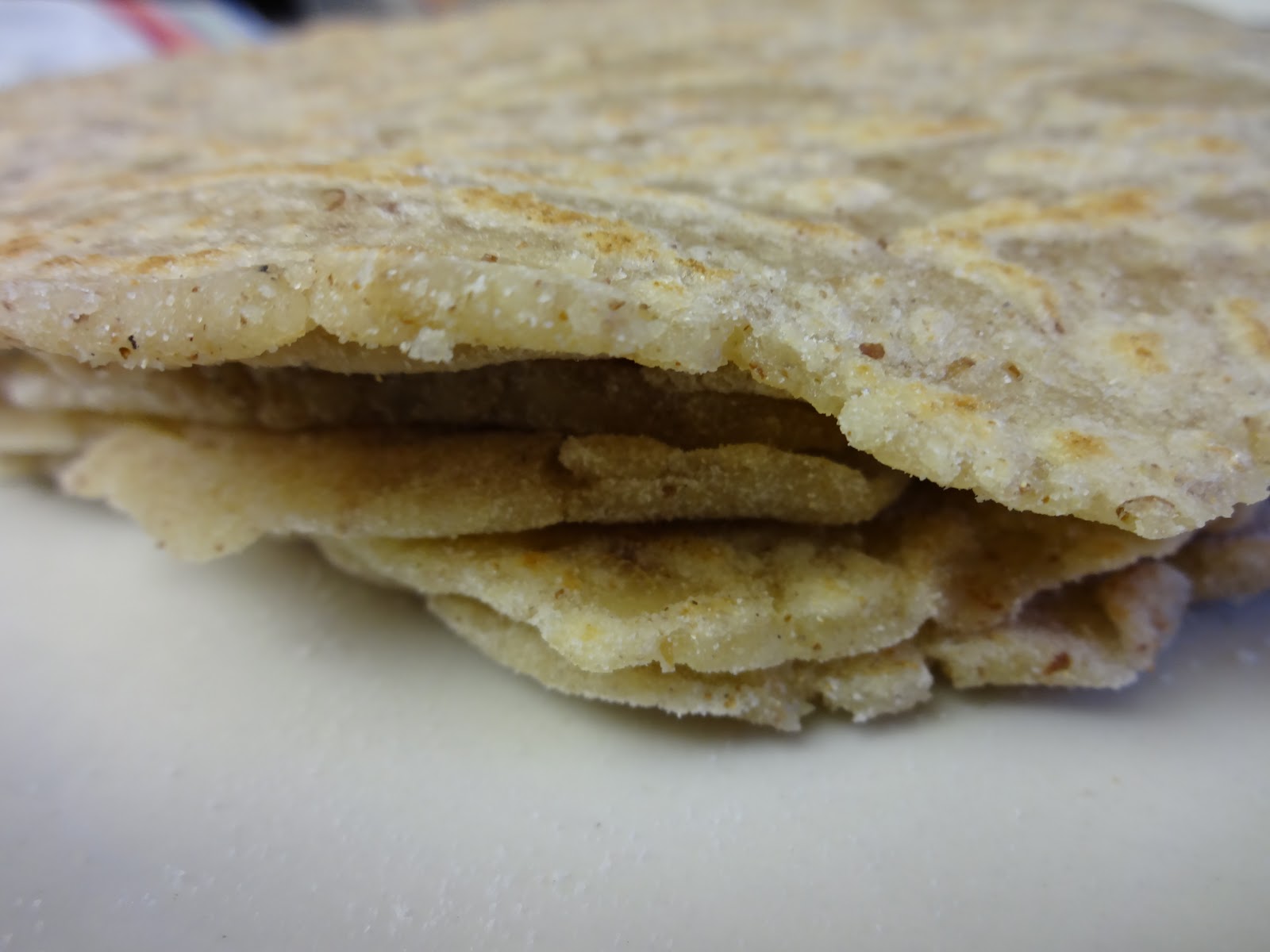
Gluten-Free Flour Tortillas


I'm sick and tired of the gluten-free "flour tortillas" I buy at the supermarket. They're strange, pasty things that don't brown. They taste awful, and worst of all, they're so brittle I can't bend them at all without breaking them. What's the point of a tortilla you can't bend?

These tortillas, on the other hand, taste pretty darn good. When they're warm, you can actually roll them all the way up for burritos, enchiladas, whatever you like. And they even get those little brown spots the way tortillas are supposed to. A word of warning, though - they don't keep. Make right beforehand if you want them to be flexible. Otherwise they dry out and get almost as brittle as the grocery store ones.

This recipe is for 8 tortillas, but you could easily double it.

  • 1/2 cup quinoa flour
  • 3/4 cup sorghum flour
  • 3/4 cup potato starch
  • 1 tablespoon psyllium husks
  • 2 tablespoons flaxseed meal
  • 1/2 teaspoon baking powder
  • 1 teaspoon salt
  • 2 tablespoons butter
  • 2 tablespoons vegetable shortening
  • 3/4 cups warm water, plus an extra 1/4 cup
  • Rice flour or other gluten-free flour, for dusting
Combine the dry ingredients. Cut in the butter and shortening using a pastry cutter until the fat is broken down into pea-sized lumps and is well incorporated into the flours. Slowly add 3/4 cups water, mixing as you go. Add the remaining 1/4 cup a tablespoon at a time if you need it. The dough should look wet and sticky but not slimy. Cover and let sit about ten minutes.

Using the rice flour, flour a large flat surface. (You can use your counter but I use an old tea towel.) Shape the dough into 8 balls, then cover and let stand about five minutes.

Working on your floured surface, shape the balls into flat discs, using your fingers or a rolling pin. work from the center outward, and stop when the disc is about eight inches in diameter and no thinner than 1/16". 

Heat an ungreased skillet over medium heat, then fry the tortillas about a minute on each side, or until they begin to puff up a little and get little golden spots on them.


My Happiness Project

I read The Happiness Project by Gretchen Rubin several weeks ago, and have been planning my own happiness project ever since. It's that kind of book - the kind that you can't put down, that gets you thinking, that's really worth a read.

What is a happiness project? Basically, it's reflecting on what makes you happy, joyful, anxious, and sad, then making concrete resolutions to make yourself more happy and less sad/mad/etc., then following through on those resolutions.  It sounds simple, but if you really want to see some big changes, it takes a lot of work. As Rubin repeats throughout the book, "Happiness doesn't always make you happy."


Gathering


I've been off the radar recently, letting the blog run more or less on autopilot.  But that doesn't mean I've been running on autopilot. I've been doing professional training, seeking a professional mentor, and starting at a new job (it's a contract deal - project-by-project, but it's been keeping me busy). That's not all. There's cooking and eating and taking care of the puppy. There's keeping the apartment more or less together, dishes...the list goes on. Life goes on.

Gluten Free Girl and the Chef

Creamy. Cheesy. Buttery. Amazing.

Do you know the gluten-free girl? You should. Her website has incredible food, mouthwatering photographs, and wonderful stories. And she has two great books, with another one on the way.

I'm a sucker for a cookbook with a story, and Gluten-Free Girl and the Chef: A Love Story with 100 Tempting Recipes is just that. When I first got this book, I couldn't put it down. Never mind that I was studying for the biggest test of my life. I just had to read every.single.word in this cookbook.  I followed Shauna (the gluten-free girl) and Danny (the Chef) as they told their stories about falling in love through food.

And the recipes. Oh boy. Get out your grocery list, because you'll want to make recipe after recipe after recipe from this book. I'm working my way through it, from veal stock to fresh gluten free pasta to crackers to creamless corn chowder. All absolutely delicious.

Last night, I made the baked eggs with taleggio. Oh. My. Mike approached it with a bit of trepidation, but he does love eggs. And when I told him there was a grand prize of cheese at the bottom, he dug right in and I didn't hear another word from him for the rest of the meal. That good. Every recipe is like that.

Breakfast for dinner - baked eggs with tallegio, bacon, and teff English muffins

An Everlasting Meal


The Salt Lake City Public Library has something called the "Lucky Day Collection" - recent books that are highly sought after, and which can only be found by going to the library. They're not even listed in the library's online catalog. My mother the librarian (yes, really) thinks this is an incredible idea. And I like it because I know I can walk in the front door and find an absolute gem.

Food and the City, by Jennifer Cockrall-King


"Don't ask me if at fifty dollars a square foot, can you justify an urban agriculture program in the city of Toronto. Ask me if at $100,000 a year per juvenile at a detention center, can we not pay for one urban-agriculture program instead?"
                                   -Wayne Roberts, as quoted in  Food and the City, p. 210.


When I started this blog, I knew it wasn't going to be all about gluten free life. There's other stuff I'm really passionate about, other stuff that also gets me out of bed in the morning, other stuff that deserves to be a part of the conversation on this blog.

Enter food politics.

While Food and the City by Jennifer Cockrall-King makes no real mention of this pesky thing you and I like to call "gluten," those of us who are gluten free  can benefit from joining the conversation about food insecurity and urban agriculture. My own farmer's market is very conscious of celiacs' needs, with several vendors each week who sell gluten free breads, cookies, sauces, flavored popcorn, and who will even put gourmet gluten free toppings on your gluten free pizza crust. If more of us join this conversation, maybe we can improve food security and  the availability of healthy options for those of us living the gluten free lifestyle. 

How would you like to be nine meals from anarchy? Unless you grow all of your own food, you probably are. (p. 30). You see, grocery stores only carry three days worth of fresh food - milk, eggs, meat, and produce. Cockrall-King points out that this system is fine, until it isn't. (p. 31). September 11, 2001 and Hurricane Katrina are just two examples of when the three-day food supply became a huge problem. While the tragedies of these two events transcend the simple availability of food, it is important for us to remember that when we are dependent on food from far away, there is an inherent risk in our food security. 

When we live in peaceful suburbs, it's easy to forget that people struggle with food insecurity. But it's important to remember that it exists, often in our own backyards.  Even people in our neighborhoods may be struggling with food insecurity, due to unemployment or other financial difficulties. There are no national grocery chain stores in the city limits of Detroit. (245) How did that happen? In many other inner cities, it is several miles - a long bus ride - to the nearest grocery store. 

My urban herb garden this summer-thyme, rosemary, chives, and mint.
I also had tomatoes, bay leaf, radishes, and potatoes (not pictured).

This book does more than just highlight problems with food insecurity - it shows what real people are doing to solve it in cities around the world. Food and the City makes you wonder how we got so deep into this system without realizing the damage it does to the environment, to the economy, to our cultures. But at the same time, it makes you realize there's a feasible way out: urban agriculture. Without ripping out fountains and park benches, we can start using municipal land to grow food. Cities can do this by looking for spaces that are never utilized, like utility corridors, flood plains, and general green space. (225) We can use our own backyards, roofs, and windowsills to supplement our food supply. The impediments to the solution: the glacial pace of government (at federal, state, and local levels), agribusiness, and our own attitudes about what farming should look like. 

From LondonWaste, a green-waste collection program that diverts 45,000 metric tons of organic waste away from landfills yearly, to rooftop gardens, to Small Plot Intensive (SPIN) farming, to plans for using carbon dioxide emissions from kombucha to support plant growth in a vertical farm, Food and the City explores ways people around the world are already finding ways to solve food insecurity through urban agriculture. 

And when we all pitch in to solve food insecurity, strange things happen. Neighborhoods get nicer. At-risk teenagers get into less trouble. Drug dealers stop frequenting areas that have flowers and watchful eyes tending them. Urban blight starts to recede. Communities grow closer together. 

I have only one question. How can we afford not to join in this movement?

The Country Cooking of France, by Anne Willan

The discovery of a new dish does more for human happiness than the discovery of a new star.
-Jean-Anthelme Brillat-Savarin, The Physiology of Taste

This cookbook is far more than a new dish, or a new star. It's a little bit of both. If I could sum it up in a nutshell, I would call this cookbook a modern and slightly condensed take on Julia Child's Mastering the Art of French Cooking.  (In fact, Willan is known for starting a cooking school with Julia Child and James Beard.) Besides the recipes and techniques, which focus on country cooking (as opposed to Parisian cuisine), The Country Cooking of France is complete with breathtakingly mouthwatering photographs of many of the recipes contained within its pages, as well as scenes of life in the French countryside.


Besides gorgeous photographs, this cookbook has several vignettes in each chapter - about types of food, chefs, locations, and agriculture in the French countryside. I learned a lot from these little accounts, like the reason cheese gets stringy - the protein and fat get too hot.  Or that some cheeses have AOC status - just like wine - and the requirements for the prestigious labels are stringent, like requiring the cows' diet to consist entirely of summer grass and no grain-feed. No wonder the French are obsessed with cheese!

Starting on Sunday, and with the exception of Monday, we've eaten one new recipe from this cookbook every day this week. I was even inspired to have French-style fruit and cheese plates for lunch, complete with a single square of dark chocolate. I haven't fixed tonight's meal yet (Tian de Courgettes), but so far every single meal has been nothing short of spectacular.


How do you follow a recipe when you cannot eat one of the main ingredients (wheat) the cookbook celebrates? Well, first of all you choose recipes carefully, unless you're an expert. I picked recipes where I knew I could make substitutions, or where none were required at all because all of the ingredients were naturally gluten free. The Boeuf Bourguignon, for example, used flour as a thickener. Instead, I used an all-purpose gluten free flour blend, which did the trick just fine. Just to get in the mood for the week, I made gluten free French rolls, which I used for bread whenever it was called for in a recipe.  And for the Quiche Lorraine, I found a recipe for a gluten free pie tart elsewhere. It may be a little bit of extra work, but in my mind it's well worth it. 

Here's a recipe I made which is loosely based on a recipe in the cookbook. Give it a shot! It's excellent for a light meal, or as a first course.

My French Cooking Week Bonus  -  Salade au Gambas Grilles (Salad with Seared Shrimp) 


Let me make a confession: somewhere along the way, I lost my love of shrimp. When I was a kid, I lived for steamed shrimp, fried, shrimp, shrimp scampi, shrimp salad ... you know, I just loved shrimp. At some point though, shrimp lost their magic. So when I stumbled across a recipe for seared shrimp, I hesitated. But the pictures were so tantalizing, and there was shrimp in the freezer, so what did I have to lose?

Oh, boy, am I glad I gave this recipe a try. As I'm wont to do, I made up some twists along the way, turning simple shrimp into a whole salad for dinner.  Try your hand at it, and let me know how it goes for you! 

2 tablespoons butter, divided
2 tablespoons olive oil, divided
2 tablespoons vegetable oil, more if needed
1/2 cup cherry tomatoes
1/2 red bell pepper, diced
10 baby onions, peeled
2 cloves garlic, crushed
5 ounces lettuce
Juice of half a lemon
1 pound jumbo shrimp, peeled and deveined, tails on
1/4 cup cornstarch (Argo is gluten free, but be sure to double check)
1 tablespoon coarse sea salt
1/2 ounce Parmesan cheese
Freshly ground pepper

Preheat oven to 350 degrees. Combine tomatoes, peppers, onions, and garlic in a shallow baking dish. Toss with one tablespoon olive oil. Cut one tablespoon of butter into quarters, and tuck in to the dish. Cook for an hour, or until the tomatoes are bursting and the onions and garlic are soft. Remove from the oven and set aside.

Divide the lettuce among four plates. Spoon the tomato mixture evenly among the plates, reserving any cooking oil in the bottom of the pan. Whisk the reserved cooking oil with the lemon juice. 

Add the remaining butter and oil to a large skillet. Combine the sea salt and cornstarch in a bowl, and toss in the shrimp to coat. Heat the skillet over medium heat until nearly smoking, then add the shrimp in a single layer. Weight the shrimp with a heavy pan and cook for a minute or two. Remove the weight, turn the shrimp, reweight, and cook another one or two minutes. Remove from heat.

Divide the shrimp equally among the four plates. Top with shavings of Parmesan cheese, the lemon vinaigrette, and the pepper.

Serve immediately.